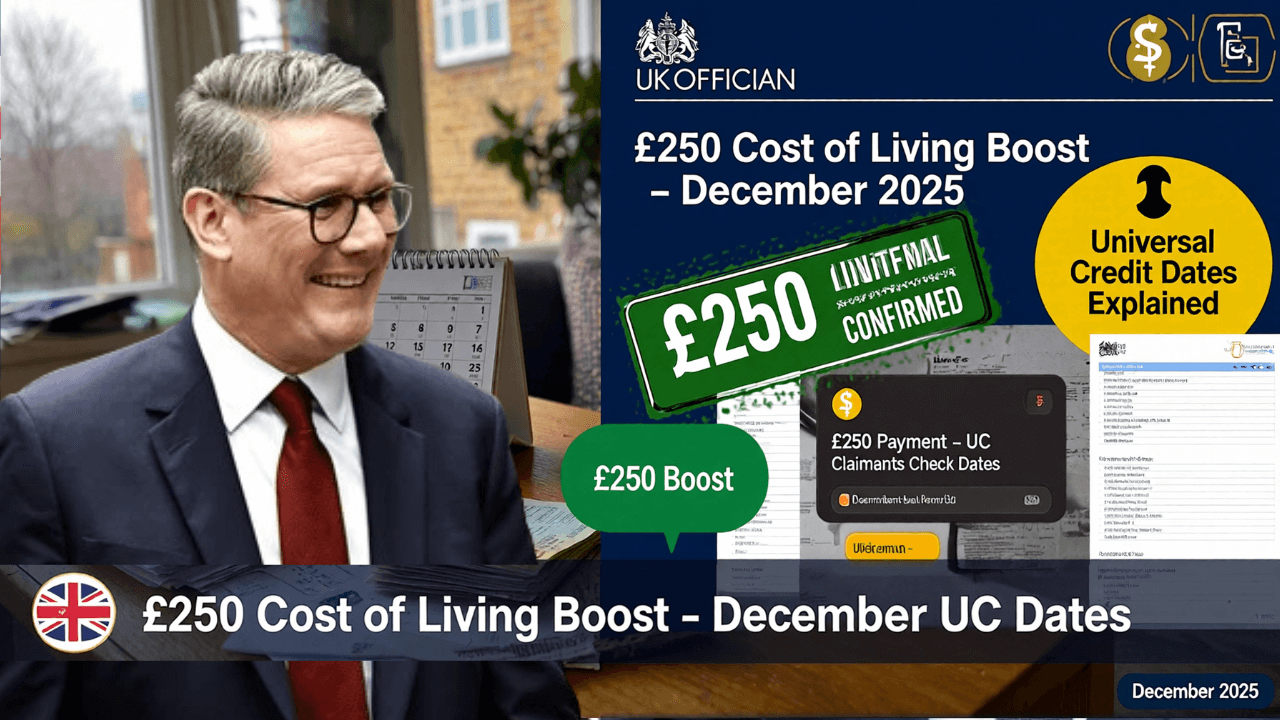
The UK Government has officially confirmed a £250 Cost of Living Boost for December 2025, offering much-needed financial relief to households already struggling with rising bills. The payment will be delivered primarily through the benefits system, with Universal Credit claimants among the main recipients.
This announcement follows months of pressure from charities, consumer groups, and MPs who warned that winter costs would remain dangerously high despite inflation easing on paper. For millions of low-income households, this payment could make the difference between coping and falling behind.
Here is everything UK residents need to know about the £250 December 2025 Cost of Living Boost, including who qualifies, when Universal Credit payments will arrive, and what claimants should do next.
What is the £250 Cost of Living Boost
The £250 Cost of Living Boost is a one-off government support payment designed to help vulnerable households manage winter expenses. These include heating bills, food costs, rent pressures, and everyday essentials that continue to rise faster than wages.
Unlike loans or advance payments, this support does not need to be repaid. It is separate from standard monthly benefit payments and will be paid automatically to eligible claimants.
The Department for Work and Pensions (DWP) confirmed that the payment forms part of its winter support strategy for 2025, targeting households most affected by ongoing cost pressures.
Why the payment is being issued in December 2025
December is traditionally one of the most expensive months for UK households. Energy usage increases sharply, food spending rises over Christmas, and many families face added travel and childcare costs.
Despite previous cost of living support packages, the government acknowledged that winter 2025 remains financially challenging, particularly for those on fixed or low incomes. The £250 boost is intended to arrive at the point when households need it most.
Ministers have described the payment as targeted, timely, and focused on essentials, rather than a broad cash giveaway.
Who qualifies for the £250 payment
Eligibility is linked to receiving certain income-related benefits during a specific assessment period. While final eligibility dates will be confirmed closer to December, the government has stated that the following groups are expected to qualify:
- Universal Credit claimants
- Income-based Jobseeker’s Allowance recipients
- Income-related Employment and Support Allowance recipients
- Income Support claimants
- Pension Credit recipients
- Tax Credit claimants meeting income thresholds
You only need to receive one qualifying benefit to be eligible. There is no need to apply separately if you meet the criteria.
Universal Credit claimants and eligibility
Universal Credit recipients form the largest group eligible for the £250 Cost of Living Boost. If you receive Universal Credit during the qualifying assessment window, you should receive the payment automatically.
Importantly, there is no minimum earnings requirement, meaning both working and non-working claimants may qualify as long as they receive a Universal Credit payment for the relevant period.
Couples claiming jointly will receive one £250 payment per household, not per individual.
Universal Credit payment dates explained
The £250 boost will not replace your normal Universal Credit payment. Instead, it will be paid separately, usually into the same bank account where you receive your benefit.
Based on previous cost of living payments, most Universal Credit claimants can expect the £250 payment to arrive between early and mid-December 2025. Exact dates may vary depending on your assessment period and payment schedule.
The payment will appear in your bank statement with a reference similar to “DWP COL” or “Cost of Living Payment”.
Do you need to apply for the £250 boost
No application is required.
If you are eligible, the payment will be made automatically. The DWP has stressed that claimants do not need to contact Universal Credit, Jobcentre Plus, or HMRC to request the money.
Be cautious of scams. The government will never ask for bank details, passwords, or personal information via text or email to issue this payment.
How the payment affects other benefits
The £250 Cost of Living Boost does not count as income for benefit calculations. This means:
- It will not reduce your Universal Credit
- It will not affect Housing Benefit
- It will not impact Council Tax Reduction
- It will not count towards savings limits
You are free to use the money as you choose, without worrying about it affecting future benefit entitlement.
Pensioners and the £250 payment
Pensioners receiving Pension Credit are also expected to qualify for the £250 payment. This is particularly important, as many older households face higher heating costs and live on fixed incomes.
The government has again urged pensioners who may be eligible for Pension Credit but are not claiming it to check their entitlement urgently, as missing out could mean losing access to multiple support payments.
How this payment fits with other winter support
The £250 Cost of Living Boost is separate from other winter assistance, including:
- Winter Fuel Payments
- Cold Weather Payments
- Energy bill discounts
- Council-led Household Support Fund schemes
Eligible households may receive multiple forms of support, depending on their circumstances and local authority.
What if you do not receive the payment
If you believe you are eligible but do not receive the £250 payment by late December 2025, the DWP advises waiting until the full payment window has closed before contacting them.
Once the payment period ends, claimants will be able to report missing payments through official government channels. In most cases, delays are linked to assessment periods rather than eligibility errors.
Common reasons people miss out
Past cost of living payments show that people usually miss out for one of the following reasons:
- Not receiving a qualifying benefit during the assessment period
- Benefit claims being closed or suspended temporarily
- Changes in circumstances not reported in time
- Not claiming Pension Credit despite being eligible
Keeping your Universal Credit journal up to date and reporting changes promptly reduces the risk of missing payments.
How to prepare now
To ensure you receive the £250 payment smoothly:
- Check your Universal Credit account is active
- Make sure your bank details are correct
- Report any changes in income or household circumstances
- Watch for official DWP announcements confirming dates
There is nothing else you need to do unless your details have changed.
Why this payment matters for UK households
While £250 may not solve long-term cost pressures, it provides immediate breathing space for millions of households. For some, it will cover a heating bill. For others, it will help with food shopping, rent gaps, or debt repayments.
Charities have welcomed the payment but continue to call for longer-term solutions, including benefit uprating in line with real living costs.
Government response and public reaction
The government has described the payment as a targeted intervention, while opposition parties argue that more sustained support is needed. Public reaction has been mixed, with many welcoming the help but questioning whether it goes far enough.
What is clear is that the payment will reach millions of households at a critical time of year.
Final thoughts
The £250 December 2025 Cost of Living Boost is a confirmed and automatic payment aimed at easing winter financial pressure for low-income households across the UK. Universal Credit claimants are among those most likely to benefit, with payments expected to arrive in December without the need for applications.
For eligible households, the key message is simple: check your benefit status, keep your details updated, and remain alert for official payment confirmations. With winter costs continuing to rise, this support could provide valuable relief when it is needed most.